


Role of fashion icons: your 2026 style guide
TL;DR:
- Fashion icons influence culture and commerce by combining authentic style with consistent storytelling. Their impact has grown through social media, broadening representation and enabling faster trend adoption. Applying their principles helps individuals develop personal, memorable style rooted in authenticity and intentional choices.
Fashion icons are defined as cultural figures whose personal style consistently shapes public taste, drives purchasing decisions, and sets the direction of broader fashion trends. The role of fashion icons extends far beyond wearing beautiful clothes. They act as cultural curators, translating values, identity, and aspiration into visual language that millions of people absorb and replicate. 69% of consumers trust influencer recommendations, rivalling personal word-of-mouth. That level of trust places fashion icons among the most powerful forces in retail and culture today. Figures like Meghan Markle and Kate Middleton demonstrate this daily, turning a single outfit into a global conversation.
How do fashion icons shape trends and influence consumer behaviour?
The influence of style leaders operates through three distinct channels: media coverage, social media reach, and raw search demand. When Meghan Markle wore Australian designers during her 2026 tour, the results were immediate and measurable. Her appearances generated $51.6 million in Media Impact Value within four days, with some featured brands reporting a 250% sales increase. That is not passive celebrity glow. That is a direct commercial mechanism.
Kate Middleton shows the same pattern over a longer arc. She commands 324,000 monthly Google searches for “how to dress like her,” alongside thousands of monthly TikTok and Instagram queries. Sustained search demand at that scale means retailers can predict category interest simply by tracking what she wears. Fashion icons do not just reflect trends. They create the conditions for trends to take hold.
The mechanism behind this influence is partly psychological. Followers adopt products from fashion icons because they see themselves belonging to a community and projecting ideals of style and success. Buying the coat is not just buying the coat. It is buying into a version of identity.
The role of trends in fashion also shifts when icons are involved. What might have taken a full runway season to filter into mainstream awareness can now move from a single Instagram post to sold-out status within 48 hours.
- Icons amplify emerging trends by giving them a face and a story.
- They broaden representation by championing designers from underrepresented communities.
- They create search demand that retailers can track and respond to in near real time.
- They convert passive admiration into active purchasing behaviour.
Pro Tip: Watch what major icons wear at non-fashion events, such as airport arrivals or charity appearances. Those “off-duty” moments often predict the next wave of accessible trend adoption far more reliably than runway shows.
What are the defining characteristics of effective and enduring fashion icons?
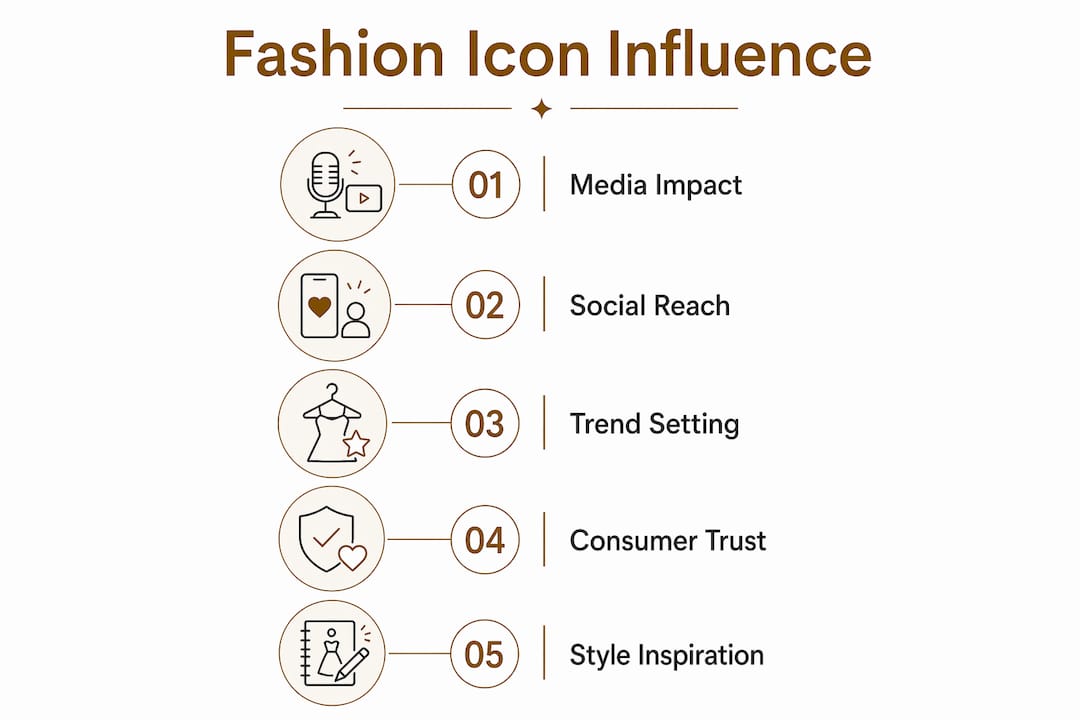
Not every celebrity becomes a lasting fashion icon. The ones who do share a specific set of qualities that go beyond good taste or access to great designers.
Consistency over novelty
True fashion icons maintain consistent aesthetic identities tied closely to their personalities or their art. Consistency breeds memorability. When an icon’s style shifts in ways that feel marketing-driven rather than personally motivated, audiences notice and trust erodes. The most enduring icons treat their wardrobe as an extension of who they are, not as a promotional vehicle.
Restraint and mystery
Enduring style icons exhibit restraint and a degree of unknowableness that preserves allure and legacy. Carolyn Bessette-Kennedy is the clearest example. Her combination of elegance and deliberate privacy created an image that fashion followers still study and copy decades later. Oversaturation destroys mystique. The icons who protect their image by choosing carefully what they show and when they show it tend to last far longer in cultural memory.
Believable aspiration
The most effective icons sit at a precise point between relatable and aspirational. They are believably relatable but aspirational, often mixing accessible high-street pieces with luxury items to demonstrate style skill rather than just spending power. This approach builds genuine trust. Followers believe they can achieve a version of the look, which converts admiration into action.
“Style icons today function as editors of desire, creating full narratives that consumers aspire to, rather than merely endorsing products. Their credibility stems from aesthetic conviction and controlled storytelling across media platforms.”
Authenticity sits at the core of all three qualities. Consumers increasingly reject commercialised, forced brand associations that lack genuine personal or historical connection. An icon who wears a brand because it fits their identity carries far more weight than one who wears it because of a contract.
In what ways have fashion icons evolved in the digital age?
The traditional fashion system placed enormous power in the hands of a small group of editors, stylists, and runway gatekeepers. That system has not disappeared, but it now coexists with a broader ecosystem where influencers and icons often set the pace and breadth of trend creation. The shift is structural, not just cosmetic.
Social media removed the barrier between an icon and their audience. A post, a reel, or a short video can reach millions of people before a single fashion journalist has filed a review. This speed has changed what fashion icon significance means in practice. Cultural impact is now measured in hours, not seasons.
The digital shift has also broadened who gets to be an icon. Influencers representing diverse body types have driven meaningful market shifts toward inclusion. Fashion icons from communities that were historically invisible in mainstream media now command audiences in the millions and shape purchasing decisions across global markets.
Figures like Pharrell Williams illustrate a further evolution. As a cultural curator blending multiple registers, he shapes not just products but the aspirational lifestyle linked to entire brands. The modern icon is not just a face. They are a creative force with genuine editorial authority.
- Digital icons build community, not just followings. Engagement and trust matter more than follower count alone.
- Authenticity online is non-negotiable. Audiences detect performative branding quickly and respond with disengagement.
- Diverse representation has expanded the definition of what a fashion icon looks like and where they come from.
- The role of influencers in fashion now overlaps significantly with the traditional icon model, creating a new hybrid category of cultural authority.
Pro Tip: Follow icons who consistently tag smaller or independent designers. These mentions often surface emerging talent months before mainstream press coverage catches up.
How can you apply fashion icon inspiration to your own personal style?
Drawing on fashion icon contributions does not mean copying an outfit. It means understanding the principles behind the choices and applying them to your own wardrobe and identity.

Style curation is the practice of building a wardrobe with intention, selecting pieces that reflect a consistent personal aesthetic rather than chasing every new trend. Icons are the best teachers of this skill because their choices are visible, documented, and often explained in interviews and behind-the-scenes content.
The most practical lesson from studying icons is the mix. Authentic style curation includes mixing affordable pieces with vintage or borrowed items, demonstrating a skill rather than a budget. This approach builds a wardrobe that feels personal and considered rather than purchased wholesale from a single trend cycle.
Use icons as guides, not templates. The goal is to identify what draws you to a particular icon’s style and then find the version of that quality that fits your own life, body, and context. Consistency in your own choices will build the same kind of recognisable identity that makes icons memorable in the first place.
| Icon-inspired principle | How to apply it to your wardrobe |
|---|---|
| Consistent aesthetic identity | Choose a colour palette and silhouette you return to repeatedly |
| Mix of accessible and elevated | Pair one investment piece with three affordable items per outfit |
| Restraint and editing | Remove one item before leaving the house; less often reads as more |
| Storytelling through clothing | Select pieces that connect to places, memories, or values you hold |
| Community and belonging | Dress in ways that signal your actual interests and identity |
Key takeaways
Fashion icons shape culture and commerce by combining authentic personal style with consistent storytelling, and the most enduring ones protect their influence through restraint, relatability, and genuine aesthetic conviction.
| Point | Details |
|---|---|
| Trust drives purchasing | 69% of consumers trust influencer recommendations, rivalling personal word-of-mouth. |
| Icons create measurable impact | Meghan Markle’s 2026 tour generated $51.6 million in Media Impact Value in four days. |
| Consistency builds longevity | Icons who maintain a stable aesthetic identity retain audience trust far longer than those who shift for marketing reasons. |
| Digital access broadened the field | Social media removed traditional gatekeepers and allowed diverse voices to become fashion icons. |
| Style curation is a learnable skill | Mixing accessible and elevated pieces demonstrates style skill, not spending power. |
Why I think we underestimate what fashion icons actually do
Fashion icons are often discussed as if their primary function is commercial. Brands pay them, sales go up, everyone moves on. That framing misses the deeper work.
What I find genuinely interesting about the most enduring icons is how little of their influence is deliberate in the transactional sense. Carolyn Bessette-Kennedy never had a brand deal. She had a point of view. That point of view has outlasted almost every paid campaign from the same era. The icons who last are the ones who treat their style as a form of communication rather than a revenue stream.
The digital age has made this harder to maintain. The pressure to post constantly, to partner with every brand that reaches out, and to stay visible at all costs works directly against the restraint that creates lasting allure. The icons I watch most carefully in 2026 are the ones who still say no. They protect their image not by being secretive but by being selective.
For fashion enthusiasts, the most useful shift in perspective is to stop asking “what is she wearing?” and start asking “why does this feel coherent?” The answer to that second question is where the real education in personal style lives. It is about identity, not inventory.
The future of fashion icon significance will belong to those who build genuine community, champion sustainability without making it a performance, and represent the full breadth of who actually wears clothes. That is a wider field than it has ever been, and that is genuinely exciting.
— Glenville
Style inspired by icons, available at 16thavenue
Fashion icons teach us that great style comes from considered choices, not endless spending. 16thavenue curates pieces that make those considered choices easy.
The women’s autumn and winter woolen coat at 16thavenue delivers the kind of clean, structured outerwear that icons reach for when they want to look effortlessly put-together. For everyday movement, the comfort sport sneakers bring the accessible-meets-elevated mix that defines modern icon style. When the season calls for it, the fashion snow boots combine function and visual confidence in exactly the way the best-dressed women always have. Free shipping to most destinations makes building your curated wardrobe even simpler.
FAQ
What is the role of fashion icons in shaping trends?
Fashion icons shape trends by giving emerging styles a face, a story, and a community to belong to. Their choices generate search demand, media coverage, and direct sales that move entire product categories.
Why do consumers trust fashion icons so much?
69% of consumers trust influencer and icon recommendations at a level that rivals personal word-of-mouth, because icons demonstrate style skill through consistent, authentic choices rather than purely paid endorsements.
What makes a fashion icon endure beyond a single trend cycle?
Enduring icons maintain a consistent aesthetic identity tied to their personality or values, practise restraint to preserve allure, and avoid oversaturation. Carolyn Bessette-Kennedy remains a studied example of this approach.
How have fashion icons changed in the digital age?
Social media removed traditional gatekeepers and allowed diverse voices, including influencers representing varied body types and cultural backgrounds, to become fashion icons with genuine commercial and cultural influence.
How can I use fashion icons to develop my own personal style?
Use icons as guides rather than templates. Identify the underlying principle behind their choices, such as a consistent colour palette or the mix of accessible and elevated pieces, and apply that principle to your own wardrobe and identity.