


Your style workflow for 2026: work smarter, dress better
TL;DR:
- A well-designed personal style workflow for 2026 emphasizes a structured, AI-supported process that reduces guesswork and enhances intentionality. It relies on four key AI tools—Claude, Figma, Cursor, and Codex—that serve distinct functions for ideation, visual planning, rapid prototyping, and automation. Applying current design trends like Glassmorphism 2.0 and Bento Grid, along with principles of slow browsing, helps create a balanced, minimalist wardrobe aligned with personal identity.
A well-built personal style workflow for 2026 is defined as a structured, tool-supported process that moves you from wardrobe audit to finished outfit with less guesswork and more intention. The most effective version of this process combines AI tools like Claude, Figma, Cursor, and Codex with 2026 design trends such as Glassmorphism 2.0 and slow browsing to cut decision fatigue and sharpen your personal aesthetic. This guide breaks down the exact tools, trends, and methods you need to build a creative process that actually fits your life. Whether you are planning a seasonal refresh or rethinking your entire wardrobe strategy, the steps here are practical, specific, and built for real results.
What essential tools define the style workflow for 2026?
The strongest creative process for 2026 is built on four focused AI tools, each with a distinct role. Top designers confirm that the best workflows use a few specialised tools rather than a bloated stack. That principle applies directly to personal styling.

Claude handles ideation and conceptual thinking. You feed it a mood, a colour palette, or a style reference, and it returns structured ideas, outfit concepts, and trend analysis. It is the thinking layer of your workflow.
Figma is the visual workspace. Designers use it for prototyping, but for personal styling it works as a digital mood board and outfit planner. You can drag in clothing images, arrange looks, and visualise combinations before you buy or wear anything.
Cursor translates concepts into workable outputs. In a styling context, it helps you build templates, shopping lists, and outfit schedules quickly. Codex automates the repetitive parts, such as generating weekly outfit rotations or tagging wardrobe items by season and occasion.
| Tool | Primary Role | Styling Use Case |
|---|---|---|
| Claude | Ideation and research | Generate outfit concepts and trend briefs |
| Figma | Visual design and layout | Build digital mood boards and outfit grids |
| Cursor | Rapid prototyping | Create outfit templates and shopping frameworks |
| Codex | Task automation | Automate outfit scheduling and wardrobe tagging |
Reducing tool switching and manual tasks increases workflow speed significantly. Every time you jump between unrelated apps, you lose momentum and introduce errors.
Pro Tip: Set a rule for yourself: one tool per task. Claude for thinking, Figma for seeing, Cursor for building, Codex for repeating. Mixing their roles creates confusion, not creativity.
How do 2026 design trends shape a balanced style aesthetic?
The 2026 design trends reshaping digital aesthetics are directly translatable to personal style decisions. Glassmorphism 2.0 has reached 60% adoption among leading design platforms. This trend favours frosted, layered visuals with soft transparency. In wardrobe terms, it translates to tonal dressing, sheer layering, and muted colour palettes with subtle depth.
Bento Grid layouts have 45% market penetration in 2026 design work. The Bento approach organises content into clean, modular blocks. Applied to styling, this means building a wardrobe in distinct capsule groups rather than a chaotic mix of individual pieces. Each “block” serves a clear purpose: workwear, weekend, occasion, and active.
AI-generated illustrations now appear in 35% of design projects. For styling, this signals a shift toward using AI tools to generate visual inspiration rather than scrolling endlessly through social media feeds.
The slow browsing concept is the most underrated trend of 2026. Slow browsing reduces digital distractions and focuses user attention on purposeful content. Applied to fashion, it means curating fewer, better references rather than consuming hundreds of trend images with no clear direction.
Here is how to apply these trends to your wardrobe planning:
- Build a tonal capsule inspired by Glassmorphism 2.0: choose three to four colours that layer naturally together
- Organise your wardrobe into Bento-style capsule blocks, each with a defined purpose and occasion
- Use Claude or a similar AI tool to generate visual style briefs instead of scrolling Pinterest for hours
- Practise slow browsing by limiting your style inspiration sources to three trusted platforms per season
- Review your seasonal collection strategy before purchasing new pieces to avoid duplication
These trends share a common thread: intentional simplicity. The goal is not to follow every aesthetic but to pick the ones that reinforce your personal style identity.
What are the step-by-step methods to streamline your styling process?
A structured approach to personal styling removes the paralysis that comes from too many choices. Mapping your existing workflow before making changes is the critical first step. Automating a broken process only accelerates its problems.
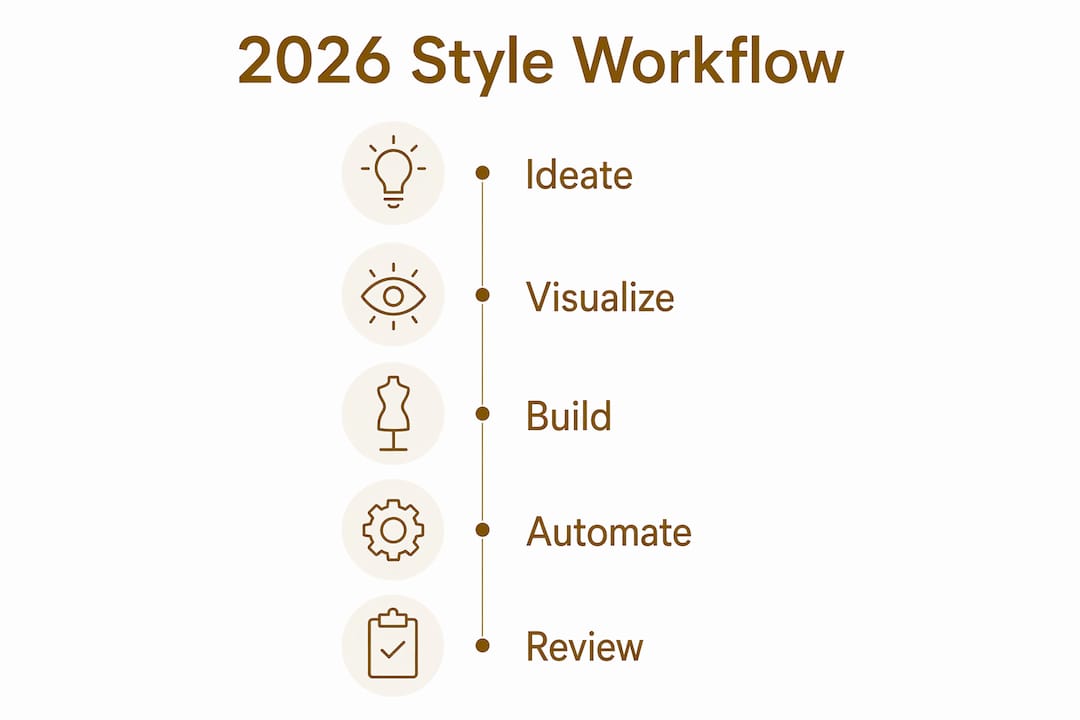
Follow this sequence to build a reliable styling process:
- Wardrobe audit. Pull everything out. Categorise by type, colour, and season. Identify gaps and redundancies. This is your baseline.
- Set style goals. Define what you want your wardrobe to communicate. Professional authority? Relaxed confidence? Weekend ease? Write it down.
- Research with Claude. Input your goals and current wardrobe gaps. Ask Claude to generate outfit concepts, trend alignments, and shopping priorities based on your defined aesthetic.
- Build visual plans in Figma. Create a simple mood board for each capsule block. Use images of pieces you own alongside aspirational items. Seeing combinations visually prevents costly mistakes.
- Validate quickly with Cursor. Use Cursor to build a simple outfit template or shopping checklist. This step confirms whether your concepts translate into real, wearable combinations.
- Automate repetitive tasks with Codex. Set up a weekly outfit rotation, a seasonal shopping list, or a wardrobe tagging system. Codex handles the mechanical work so you focus on the creative decisions.
- Review and refine. After four weeks, assess what worked. Adjust your tool use and style goals based on real experience, not theory.
The most common mistake at this stage is overcomplicating the stack. Adding five apps to solve a problem that one app handles creates friction, not efficiency. A proven fashion workflow for women consistently shows that fewer, better decisions outperform more frequent, scattered ones.
Pro Tip: Let AI generate the first draft of any outfit concept, then edit it with your own taste. AI supports human judgment rather than replacing it. Your personal aesthetic is the filter that makes the output worth wearing.
How can workflow optimisation increase efficiency without sacrificing style quality?
Optimising your styling workflow means removing steps that consume time without improving outcomes. Agentic workflow optimisation can reduce unnecessary process steps by 11.9% and increase task success by 4.2 percentage points. That research applies to AI model pipelines, but the logic transfers directly to personal styling systems.
The concept of meta-tool bundling is central here. Instead of running Claude, then Figma, then Cursor as three separate sessions, you bundle them into a single creative sprint. Claude generates ideas, Figma captures them visually, and Cursor produces the output template, all within one focused work block. Context switching between these tools outside a structured sprint wastes time and breaks creative momentum.
Quality control is the other half of the equation. Professional design teams maintain a 5:1 AI output to human review ratio to balance speed with taste. For personal styling, this means reviewing one in every five AI-generated outfit suggestions in depth rather than accepting all of them without critical thought. That ratio keeps your wardrobe feeling personal, not algorithmic.
Setting measurable goals matters as much as the tools you choose. A 30-day pilot with clear targets reduces risk and validates whether your new process actually delivers results. For styling, a useful target might be: reduce outfit decision time by 50% within 30 days, or complete a full seasonal wardrobe plan in under three hours.
| Optimisation Tactic | Benefit | How to Apply |
|---|---|---|
| Meta-tool bundling | Fewer context switches, faster output | Run Claude, Figma, and Cursor in one focused session |
| 5:1 review ratio | Maintains personal taste and quality | Deeply review one in five AI outfit suggestions |
| 30-day pilot with goals | Validates changes, reduces disruption | Set a measurable target before committing to new tools |
| Bottleneck mapping | Removes steps that slow you down | Audit your current process before adding automation |
| Redundancy removal | Saves time on repeated manual tasks | Identify tasks you do more than once and automate them |
The fashion shopping workflow in 2026 shows that shoppers who use structured processes report 25% faster decisions and 30% fewer returns. Optimisation is not about moving faster for its own sake. It is about spending your creative energy where it counts.
Key takeaways
A well-optimised style workflow for 2026 combines focused AI tools, intentional design trends, and structured review habits to produce better personal style decisions in less time.
| Point | Details |
|---|---|
| Use four focused tools | Claude, Figma, Cursor, and Codex each serve a distinct role in the styling process. |
| Apply 2026 design trends | Glassmorphism 2.0, Bento Grid, and slow browsing translate directly into wardrobe planning strategies. |
| Map before you automate | Audit your current styling habits before adding new tools to avoid accelerating inefficiencies. |
| Maintain a 5:1 review ratio | Review one in five AI-generated outfit ideas in depth to preserve personal taste and quality. |
| Run a 30-day pilot | Set a measurable style goal and test your new workflow for one month before making permanent changes. |
Why i think most style advice gets the tool question backwards
The conversation around AI and personal style almost always starts with the tools. Which app is best? Which platform has the most features? That framing gets it backwards.
I have watched people build elaborate styling systems with six different apps, only to feel more overwhelmed than before they started. The problem is never a lack of tools. The problem is a lack of clarity about what you actually want your wardrobe to do for you.
The workflows that work are the ones built around a clear personal aesthetic first. The tools come second. Claude is genuinely useful for ideation, but only if you give it a clear brief. Figma is powerful for visualisation, but a cluttered mood board is worse than no mood board at all.
The slow browsing principle resonates with me precisely because it pushes back against the assumption that more input equals better output. Limiting your style references to three trusted sources per season forces you to develop an actual point of view rather than constantly reacting to what you see online.
My honest advice: pick two tools, master them completely, and build your workflow around your taste rather than around the technology. The 2026 fashion trends guide is a useful starting point for identifying which trends actually align with your existing aesthetic before you commit to anything new.
— Glenville
Build your 2026 wardrobe with 16thavenue
16thavenue curates seasonal collections that do the trend research for you, so your styling workflow starts with pieces that are already worth building around.
The Women’s Trendy Autumn and Winter Woolen Coat is a strong anchor piece for any cold-weather capsule, designed to layer cleanly with tonal palettes inspired by Glassmorphism 2.0 aesthetics. For versatile everyday movement, the breathable sport sneakers from 16thavenue work across multiple capsule blocks without compromising comfort or style. Free shipping to most destinations means your wardrobe refresh arrives without added friction. Explore the full collection at 16thavenue.ca and let the curation do the heavy lifting.
FAQ
What is a style workflow for 2026?
A style workflow for 2026 is a structured process that uses AI tools and trend-informed planning to move from wardrobe audit to finished outfit decisions with less effort and more consistency. It replaces ad hoc styling choices with a repeatable, goal-driven system.
Which AI tools work best for personal styling?
Claude handles ideation, Figma manages visual planning, Cursor builds templates, and Codex automates repetitive tasks like outfit scheduling. Top designers recommend assigning each tool one clear role to avoid overlap and confusion.
How do 2026 design trends apply to personal wardrobes?
Glassmorphism 2.0 translates into tonal, layered dressing. Bento Grid thinking organises your wardrobe into distinct capsule blocks. Slow browsing means curating fewer, better style references rather than consuming trend content without direction.
How do i know if my style workflow is actually working?
Set a measurable goal before you start, such as reducing outfit decision time by 50% in 30 days. A structured 30-day pilot with clear targets is the most reliable way to validate whether your new process delivers real results.
Should i let AI make my style decisions?
No. AI works best when it supports human judgment rather than replacing it. Use AI to generate options and surface ideas, then apply your own taste as the final filter. Your personal aesthetic is what makes the output feel like you.