


Role of Trends in Fashion – Shaping Style and Retail
Choosing the perfect outfit is more than a daily routine—it is a way to express identity in a world where style signals deeper stories. Fashion trends are not just fleeting styles but powerful forces that shape how women connect with culture, values, and each other. With digital platforms and global networks accelerating trend diffusion, understanding these dynamic social phenomena empowers you to make style choices that reflect who you are and where the world is going.
Table of Contents
- Defining Fashion Trends And Their Influence
- Key Types Of Trends In Modern Fashion
- How Trends Emerge And Spread Globally
- Consumer Power And Social Influence On Trends
- Impacts On Retail: Business Strategies And Risks
- Staying Ahead: Leveraging Trends Responsibly
Key Takeaways
| Point | Details |
|---|---|
| Understanding Fashion Trends | Fashion trends are complex social phenomena that communicate cultural narratives, reflecting identity and values beyond mere aesthetics. |
| Types of Trends | Trends can be classified into Micro, Macro, Mega, Seasonal, and Cyclical categories, each influencing style evolution differently. |
| Consumer Power | Modern consumers actively shape trends through social media and digital platforms, challenging traditional fashion hierarchies and advocating for sustainability. |
| Retail Strategies | Successful fashion retailers prioritise agility, sustainability, and digital integration to meet evolving consumer expectations and navigate market risks. |
Defining Fashion Trends and Their Influence
Fashion trends represent more than just clothing styles - they are powerful social phenomena that reflect and communicate complex cultural narratives. Emerging through intricate societal dynamics, these trends become visual languages through which individuals express identity, values, and social positioning.
At their core, fashion trends emerge from a sophisticated interplay of cultural, psychological, and economic forces. Social Communication occurs through clothing choices, where every outfit becomes a strategic statement about personal and collective experiences. These trends are not random; they represent carefully choreographed expressions of:- Cultural zeitgeist and contemporary mood- Socioeconomic shifts and aspirational values- Individual and collective identity negotiations- Technological and global interconnectednessGlobal fashion communication networks have dramatically accelerated trend diffusion, transforming how styles spread across geographical and cultural boundaries. Social media platforms, digital influencers, and instantaneous global communication have compressed trend lifecycles, making fashion more dynamic and responsive than ever before.
Understanding fashion trends requires recognizing them as complex sociological phenomena. They are not merely aesthetic choices but intricate systems of communication that reveal profound insights about human social behavior, cultural evolution, and personal expression.
Pro tip: Pay attention to the subtle cultural signals in your clothing choices - they communicate far more than you might initially realize.
Key Types of Trends in Modern Fashion
Modern fashion trends are far more complex than simple style shifts. Fashion trend classifications reveal intricate dynamics that help industry professionals and consumers understand style evolution. These trends operate across multiple scales and timeframes, each serving a unique role in cultural expression.
Fashion trends can be categorized into distinct types that reflect different levels of societal influence:
- Micro-Trends: Short-lived styles lasting weeks to months
- Macro-Trends: Broader societal shifts spanning several seasons
- Mega-Trends: Extensive global movements transforming fashion landscapes
- Seasonal Trends: Regularly changing styles tied to specific times of year
- Cyclical Trends: Historical styles that periodically resurface and get reinterpreted
Modern trend classifications demonstrate how fashion is deeply interconnected with technological, cultural, and social developments. These trend types aren’t isolated - they interact and influence each other, creating a dynamic ecosystem of style communication.
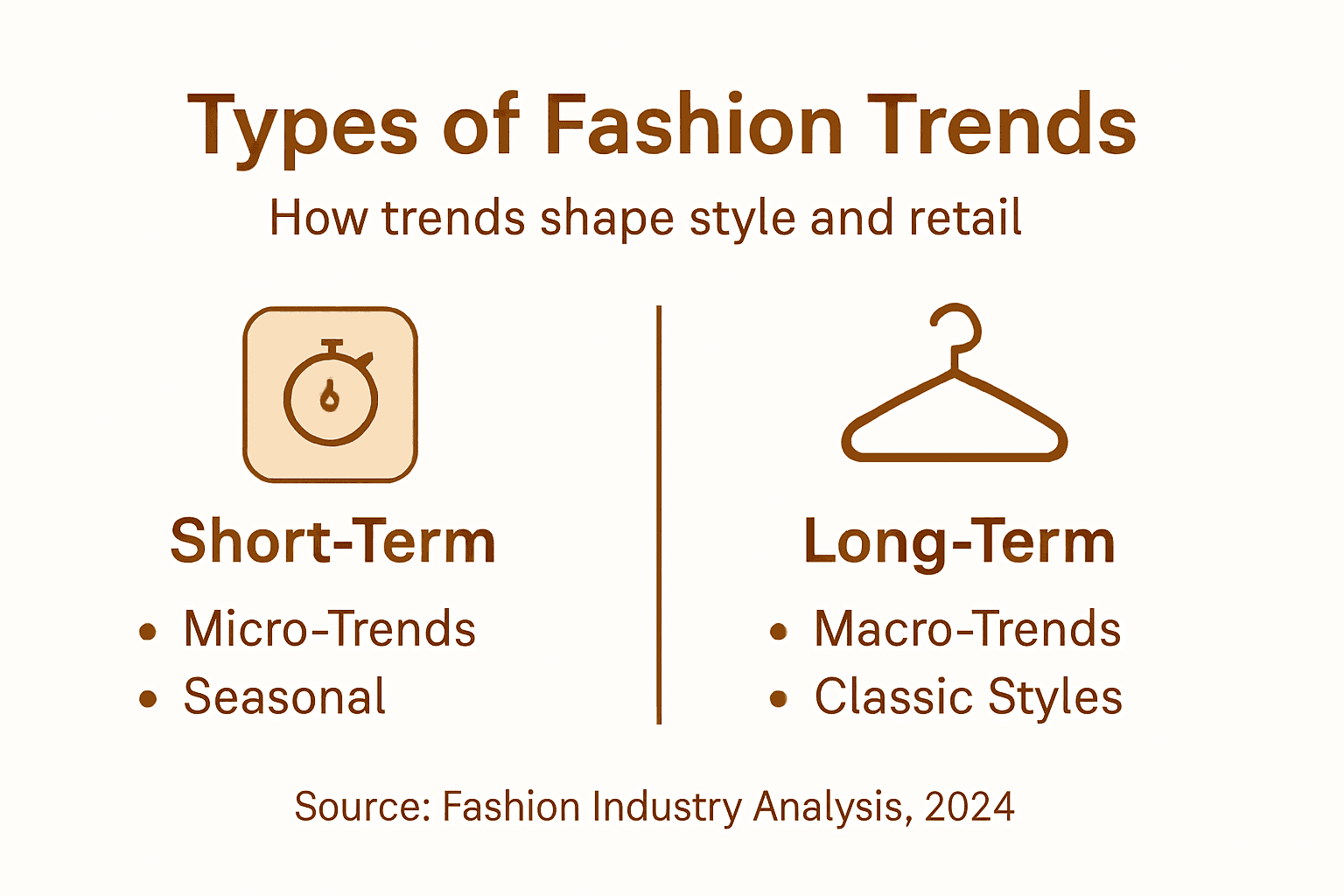
Understanding these trend categories helps consumers and designers navigate the complex world of fashion more strategically, anticipating shifts and making informed style choices.
Here’s a comparison of the key fashion trend types and their impact on style development:
| Trend Type | Duration | Societal Scope | Influence on Fashion |
|---|---|---|---|
| Micro-Trend | Weeks to months | Limited communities | Drives short-term novelty |
| Macro-Trend | Seasons to years | National | Guides mainstream shift |
| Mega-Trend | Decades | Global | Redefines fashion standards |
| Cyclical Trend | Varies, recurring | Across generations | Revives historic styles |
| Seasonal Trend | One season | Regional | Shapes timely design focus |
Pro tip: Track multiple trend levels to develop a more nuanced and adaptable personal style.
How Trends Emerge and Spread Globally
Global fashion trend propagation represents a complex ecosystem of cultural exchange and digital communication. Today’s fashion landscape is dramatically different from previous decades, with trends emerging and spreading at unprecedented speeds across geographical and cultural boundaries.
The emergence of trends involves multiple key influencers and channels:
- Digital Platforms: Social media and online networks
- Celebrity Endorsements: Influential personalities driving style adoption
- Design Communities: Professional designers and fashion houses
- Subcultural Movements: Grassroots style innovations
- Global Media Channels: Fashion magazines and digital content creators
Trend diffusion mechanisms now operate through interconnected digital ecosystems. Technological advancements have transformed how styles are conceived, shared, and adopted. What once took months or years to spread globally can now become a worldwide phenomenon within days or even hours.

The democratization of fashion through digital platforms has fundamentally altered trend dynamics, enabling consumers to become active participants rather than passive recipients of style information. This shift has created a more dynamic, responsive, and inclusive fashion environment.
Pro tip: Follow diverse global fashion sources to develop a more nuanced understanding of emerging trends.
Consumer Power and Social Influence on Trends
Consumer-driven fashion dynamics have fundamentally transformed how trends emerge and spread in the digital age. Modern consumers are no longer passive recipients of fashion directives but active participants who shape, critique, and redefine style narratives through their collective engagement and digital platforms.
Key mechanisms of consumer influence include:
- Social Media Amplification: Viral content and user-generated trends
- Peer Recommendation Networks: Word-of-mouth digital influence
- Ethical Consumption Movements: Demanding sustainable and responsible fashion
- Influencer Ecosystems: Individual content creators driving style adoption
- Community-Driven Trend Creation: Grassroots style innovations
Social dynamics in fashion markets reveal a profound shift from top-down trend dissemination to a more democratic, interactive model. Consumers now leverage digital platforms to challenge traditional fashion hierarchies, creating collaborative environments where individual voices collectively shape global style narratives.
This transformation represents more than a technological shift - it’s a fundamental reimagining of how fashion is conceived, communicated, and consumed in a globally connected world.
Pro tip: Cultivate a diverse digital network to stay ahead of emerging fashion trends and understand their deeper cultural contexts.
Impacts on Retail: Business Strategies and Risks
Retail fashion strategies are undergoing radical transformations driven by rapidly changing consumer expectations and technological disruptions. Modern fashion retailers must navigate an increasingly complex landscape where agility, sustainability, and digital responsiveness are critical for survival.
Key strategic considerations for fashion retailers include:
- Supply Chain Flexibility: Rapid adaptation to emerging trends
- Digital Integration: Seamless online and offline shopping experiences
- Personalization Technologies: Tailored marketing and product recommendations
- Sustainable Production: Ethical and environmentally conscious manufacturing
- Data-Driven Decision Making: Predictive analytics for trend forecasting
Circular fashion business models are emerging as critical strategies to mitigate environmental risks and meet evolving consumer expectations. Retailers must balance trend responsiveness with long-term sustainability, recognizing that consumer loyalty now depends on ethical practices and transparent production processes.
The most successful fashion businesses will be those that can rapidly interpret consumer signals, leverage technological innovations, and maintain a commitment to sustainable, responsible practices.
Below is a summary of strategic retail responses to fast-changing fashion trends:
| Strategy | Business Impact | Risk if Ignored |
|---|---|---|
| Supply Chain Flexibility | Faster product turnaround | Missed trend windows |
| Digital Integration | Enhanced customer experience | Loss of market share |
| Personalization Tech | Greater consumer loyalty | Lower conversion rates |
| Sustainable Production | Improved brand reputation | Regulatory & PR issues |
| Data-Driven Decisions | Accurate trend forecasting | Stock waste, inefficiency |
Pro tip: Invest in adaptive technologies and sustainability frameworks to future-proof your fashion retail strategy.
Staying Ahead: Leveraging Trends Responsibly
Fashion trend forecasting strategies represent a critical intersection between innovation, consumer understanding, and ethical responsibility. Modern fashion brands must develop nuanced approaches that balance trend responsiveness with sustainable practices, recognizing that today’s consumers demand more than just aesthetic appeal.
Key principles for responsible trend leveraging include:
- Ethical Sourcing: Prioritizing transparent supply chains
- Environmental Consciousness: Minimizing ecological footprint
- Cultural Sensitivity: Respecting diverse global perspectives
- Inclusive Design: Representing multiple body types and identities
- Long-Term Sustainability: Creating versatile, durable fashion pieces
Sustainable marketing strategies demonstrate that brands can simultaneously meet consumer trend expectations while maintaining robust ethical standards. By integrating environmental and social governance into core business models, fashion companies can transform trend responsiveness from a potential risk into a significant competitive advantage.
The most successful fashion strategies will be those that view trends not as transient aesthetic phenomena, but as opportunities for meaningful cultural dialogue and positive societal transformation.
Pro tip: Develop a holistic trend strategy that balances innovation, consumer desires, and long-term sustainability.
Embrace Emerging Fashion Trends with Confidence and Style
Navigating the fast-paced world of fashion trends can feel overwhelming. The article highlights the vital need for trend awareness, responsible consumption, and adaptability in today’s dynamic retail environment. Whether you are drawn to micro-trends or mega-trends, understanding how these styles evolve globally empowers you to express your unique identity while staying ahead with ethically conscious choices.
At 16th Avenue, we understand the challenge of balancing trend responsiveness and sustainability. Our curated collections of women’s clothing, accessories, and beauty products are designed to help you blend the latest trends with timeless style. With features like seasonal updates, diverse fashion items including dresses and swimwear, and ongoing product discounts, you can confidently refresh your wardrobe to reflect the current cultural zeitgeist. Enjoy seamless shopping with free shipping and personalized service — all crafted to make your fashion journey inspiring and hassle free.
Explore the full range of trendy and sustainable fashion options at 16th Avenue today. Stay ahead of rapidly shifting trends with carefully selected styles that speak to your identity and values. Take the confident step now and transform your look with fashion that truly resonates. Discover more and shop our collections to experience fashion that moves with you.
Frequently Asked Questions
What are the different types of fashion trends?
Fashion trends can be categorized into five main types: micro-trends (short-lived styles), macro-trends (broader societal shifts), mega-trends (extensive global movements), seasonal trends (styles tied to specific times of year), and cyclical trends (historical styles that reappear). Each type plays a unique role in cultural expression and influences fashion evolution.
How do fashion trends emerge and spread?
Fashion trends emerge through a complex ecosystem involving digital platforms, celebrity endorsements, design communities, subcultural movements, and global media. Trends can spread rapidly thanks to digital communication, allowing styles to gain popularity within days or hours rather than months or years.
How can consumers influence fashion trends?
Consumers influence fashion trends through social media amplification, peer recommendations, ethical consumption movements, and the creation of community-driven trends. In the digital age, consumers actively participate in shaping style narratives rather than simply receiving directives from fashion establishments.
What strategies should retailers adopt to respond to fast-changing fashion trends?
Retailers should focus on supply chain flexibility, digital integration, personalization technologies, sustainable production, and data-driven decision-making. These strategies will help businesses adapt quickly to emerging trends and ensure they meet consumer expectations effectively.