


What is luxury fashion? a clear guide for buyers
TL;DR:
- Luxury fashion is characterized by exceptional craftsmanship, limited production, and a rich brand heritage rather than price alone. It emphasizes timeless design, exclusivity, and quality materials, setting it above other tiers in the fashion hierarchy. Authentic luxury pieces showcase meticulous finishing, natural fibers, and a history-backed identity, making them durable investments that last through repair and careful maintenance.
Luxury fashion is defined as clothing and accessories distinguished by exceptional craftsmanship, limited production, and a rich brand heritage rather than price alone. It sits at the top of the fashion market hierarchy, above contemporary, premium, and designer tiers. Houses like Chanel, Hermès, and Louis Vuitton built their reputations over decades by treating each garment as a long-term object rather than a seasonal commodity. Understanding what separates true luxury from everything else helps you spend smarter, dress better, and build a wardrobe that lasts.
What is luxury fashion, really?
Luxury fashion is not simply expensive clothing. The five core pillars that define it are exceptional craftsmanship, superior natural materials, brand heritage, limited production, and a personalised customer experience. Each pillar reinforces the others. A coat sewn from hand-selected cashmere, finished by a single artisan, and sold through one flagship boutique carries a different weight than anything produced at scale.
The fashion hierarchy progresses from mass-market through fast fashion, contemporary, premium, and designer tiers before reaching luxury at the top. Luxury brands are characterised by exclusivity and scarcity, not volume. That scarcity is deliberate. Hermès produces a finite number of Birkin bags each year, and that constraint is the product. Buyers are not just purchasing leather goods. They are purchasing access to something most people cannot have.
Luxury fashion also focuses on timeless appeal over trend cycles. A Chanel tweed jacket from 1990 reads as current today because the design was never anchored to a single season. That longevity is a feature, not an accident. It is built into the construction philosophy from the first pattern cut.
What characteristics define luxury fashion?
The characteristics of luxury fashion are visible, tactile, and traceable. They show up in the weight of a button, the alignment of a plaid at a seam, and the feel of a lining against your skin.
- Exceptional craftsmanship: Hand-finishing techniques including hand-sewn buttonholes, felled seams, and hand-basted canvases distinguish luxury tailoring from machine production. These processes take more time and cost more to execute, but they produce garments that hold their shape for decades.
- Superior natural materials: Cashmere, silk, fine leather, and Sea Island cotton appear consistently across luxury collections. Natural fibres behave differently from synthetics. They breathe, age gracefully, and respond well to repair and tailoring.
- Heritage and brand storytelling: Maison Margiela, Bottega Veneta, and Burberry each carry a founding narrative that informs every collection. Heritage is not nostalgia. It is a quality guarantee backed by decades of consistent execution.
- Limited production: Scarcity protects perceived value. Controlling distribution and limiting supply ensures that the emotional connection between brand and buyer remains intact.
- Personalised customer experience: Luxury retail extends well beyond the point of sale. Alterations, monogramming, private appointments, and after-care services are standard expectations, not add-ons.
Pro Tip: When evaluating a luxury piece, run your thumb along the interior seams. A true luxury garment will have clean, finished edges with no loose threads or raw fabric edges visible anywhere inside.
How does luxury fashion differ from premium and designer brands?
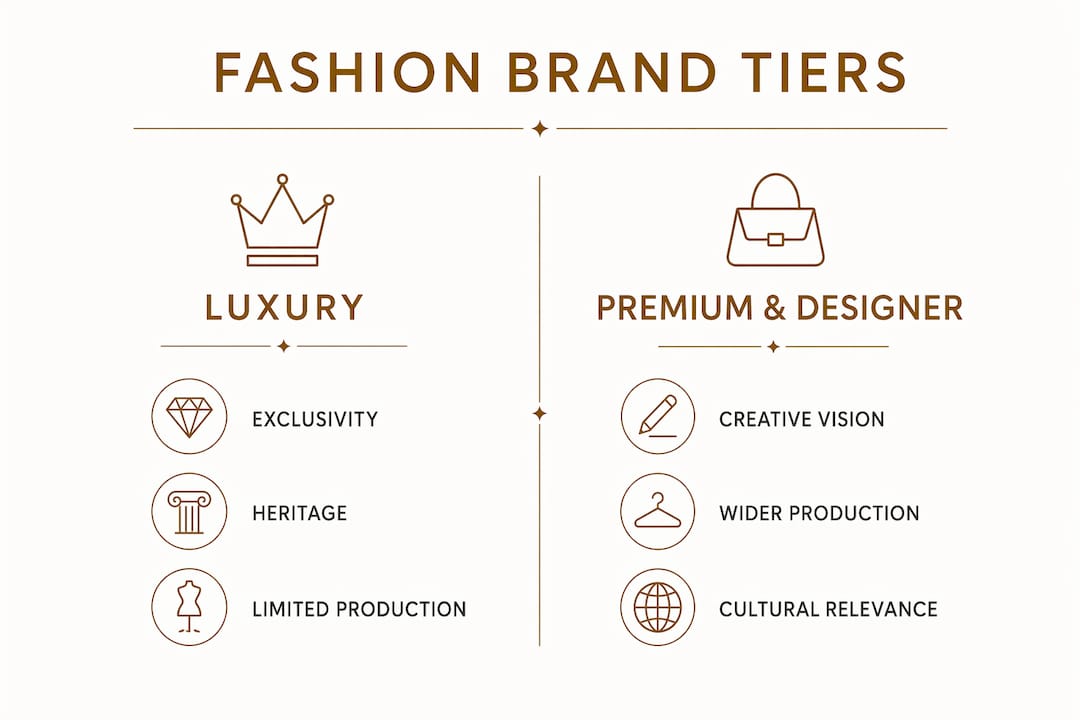
The distinction among luxury, premium, and designer brands lies in their competitive focus: exclusivity, creativity, and elevated everyday quality respectively. Buyers often conflate these tiers, which leads to overpaying for premium goods while expecting a luxury experience.
| Tier | Primary Focus | Price Range | Example Brands |
|---|---|---|---|
| Luxury | Exclusivity and heritage | $1,000+ per piece | Hermès, Chanel, Louis Vuitton |
| Designer | Creative influence and identity | $300–$1,000 | Alexander McQueen, Vivienne Westwood |
| Premium | Elevated quality at accessible price | $100–$300 | Reiss, Theory, Club Monaco |
The table above shows where each tier competes. Designer brands win on creative vision and cultural relevance. Premium brands win on quality-to-price ratio for everyday wear. Luxury brands win on scarcity, legacy, and the experience of ownership itself.
Heritage emphasis separates luxury from designer most clearly. A designer brand can be founded last decade and still command strong prices based on aesthetic alone. A luxury brand, by contrast, draws authority from a long and documented history of craft. Chanel’s founding in 1910 and Hermès’s origins as a harness maker in 1837 are not marketing footnotes. They are proof of sustained excellence.
Production scale is the other major dividing line. Premium and designer brands produce at volumes that allow wide retail distribution. Luxury brands limit distribution deliberately to protect brand prestige and perceived value. You will not find a genuine Hermès Birkin on a department store rack.
What is the quiet luxury movement?
Quiet luxury is characterised by minimal branding, emphasis on material quality, and understated design. It signals status through subtle quality rather than overt logos or displays. The movement reflects a shift in how affluent consumers want to be perceived. Loud logos read as new money. Impeccable fabric and precise tailoring read as confidence.
The materials and silhouettes associated with quiet luxury are consistent across brands. Neutral palettes, specifically camel, ivory, navy, and grey, dominate. Fabrics lean toward fine wool, cashmere, and brushed cotton. Silhouettes are clean and structured without being severe. Brands like The Row, Loro Piana, and Brunello Cucinelli built their entire identities around this aesthetic before it had a name.
| Quiet Luxury Feature | What It Signals |
|---|---|
| No visible logo | Confidence in quality over recognition |
| Neutral colour palette | Timelessness over trend |
| Natural fibres only | Commitment to material integrity |
| Minimal hardware | Restraint as a marker of taste |
Consumer behaviour is shifting to match. Buyers who once sought recognisable logos are now prioritising pieces that age well and travel across contexts. This shift has real implications for the women’s fashion trends shaping retail in 2026. Quiet luxury is not a passing moment. It is a recalibration of what status dressing means.
Pro Tip: To build a quiet luxury wardrobe without a luxury budget, prioritise fabric weight and construction over brand names. A well-cut wool coat in a neutral colour will read as luxury far more convincingly than a logo-covered piece at twice the price.
How can you identify authentic luxury fashion pieces?
Identifying genuine luxury garments requires looking past the label and examining the construction. True luxury garments focus on finishing details like hand-sewn buttonholes, seamless linings, and precise pattern alignment. These details are the real indicators of craftsmanship.
- Check the finishing details first. Open the garment and examine the lining. Luxury pieces use full linings cut from quality fabric, with seams that are finished cleanly on both sides. Pattern matching at seams, particularly at plaids or stripes, is a reliable indicator of careful construction.
- Assess material weight and texture. Hold the fabric between your fingers and feel its density. Quality cashmere has a soft, dense hand with no pilling on a new piece. Fine leather feels supple and consistent, with no stiffness or plastic-like surface.
- Look for signs of hand-stitching. Slight irregularities in stitching length are a positive sign, not a flaw. Machine stitching is perfectly uniform. Hand-stitching shows minor variation that indicates artisanal work.
- Understand brand distribution. Authentic luxury pieces are sold through tightly controlled channels. Luxury brands protect exclusivity by limiting where their products appear. If a piece is available through an unauthorised third-party seller at a steep discount, treat it with scepticism.
- Consider the maintenance philosophy. Luxury fashion adopts a maintenance-first design approach, using natural fibres designed for long-term care, repairs, and tailoring. A genuine luxury coat can be re-lined, re-hemmed, and re-fitted. Fast fashion equivalents cannot.
Pro Tip: Ask the retailer directly whether the garment can be altered or repaired by the brand. A luxury house will have an answer. A fast fashion retailer will not.
Luxury garments are evaluated more on finish than fabric alone. Subtle details like pattern matching and button weight distinguish true luxury from well-made replicas. The button test is particularly useful. Luxury buttons are heavy, precisely drilled, and sewn with a thread shank that allows the button to sit properly when fastened. Lightweight, hollow, or loosely sewn buttons are a reliable red flag.
Key takeaways
Luxury fashion is defined by craftsmanship, scarcity, and heritage, not price, and recognising these qualities helps you invest in pieces that genuinely last.
| Point | Details |
|---|---|
| Luxury sits above all other tiers | The fashion hierarchy places luxury above designer, premium, and contemporary brands based on exclusivity and heritage. |
| Five pillars define the category | Craftsmanship, materials, heritage, limited production, and personalised experience together constitute luxury fashion. |
| Quiet luxury is reshaping status dressing | Minimal branding and superior materials now signal affluence more effectively than visible logos. |
| Finishing details reveal authenticity | Check linings, pattern alignment, button weight, and hand-stitching to distinguish genuine luxury from replicas. |
| Luxury is a functional investment | Pieces designed for repair, alteration, and long-term wear deliver lasting value beyond initial purchase price. |
Why i think we’ve been measuring luxury wrong
Most conversations about luxury fashion start and end with price. That framing misses the point entirely. After years of studying how garments are constructed and how they perform over time, I’ve come to see luxury as a functional investment rather than a status purchase. The question worth asking is not “How much does this cost?” but “How will this perform in five years?”
The pieces I’ve seen hold their value and their shape are almost always the ones built with a maintenance-first philosophy. A Loro Piana overcoat can be re-lined when the lining wears through. A Hermès belt can be re-stitched when the thread frays. That repairability is not a luxury afterthought. It is the whole point. Fast fashion is designed to be replaced. Luxury is designed to be kept.
The quiet luxury movement confirms what I’ve believed for a long time. Consumers are getting more sophisticated. They are moving away from logo-driven purchases and toward pieces that reward close attention. That shift is good for the industry and good for wardrobes. It pushes buyers to learn what quality actually looks like, which makes them harder to fool and better at spending.
The emotional dimension of luxury ownership is real, but it should follow from quality, not precede it. Buy the coat because it is built to last. The feeling of wearing something exceptional will take care of itself.
— Glenville
Discover quality-driven women’s fashion at 16thavenue
If the principles of luxury fashion, quality construction, timeless design, and pieces worth keeping, resonate with you, 16thavenue offers a curated selection of women’s apparel built with those values in mind.
The Women’s Trendy Autumn and Winter Woolen Coat is a strong starting point. It reflects the clean silhouettes and quality fabrication that define the quiet luxury aesthetic, without the flagship boutique price. For footwear that pairs function with considered design, the Women’s Air-cushion Sole Fashion Snow Boots deliver comfort and style through the colder months. 16thavenue ships free to most destinations and regularly features discounts across its seasonal collections. Explore the full range at 16thavenue.ca.
FAQ
What is the simplest luxury fashion definition?
Luxury fashion is clothing and accessories defined by exceptional craftsmanship, limited production, superior natural materials, and a documented brand heritage. Price is a consequence of these qualities, not the defining characteristic.
Which luxury clothing brands are considered the top houses?
Hermès, Chanel, Louis Vuitton, Bottega Veneta, and Brunello Cucinelli are consistently ranked among the top luxury fashion houses globally. Each brand combines long heritage with tight control over production and distribution.
How does quiet luxury differ from traditional luxury fashion?
Quiet luxury removes visible logos and overt branding, signalling status through material quality and precise tailoring instead. Traditional luxury may use recognisable monograms or hardware, while quiet luxury relies on subtlety and restraint.
What makes fashion luxury versus just expensive?
A garment is luxury when it combines hand-finishing techniques, natural fibres, limited production, and a brand legacy that guarantees consistent quality. Expensive clothing without these attributes is premium at best, not luxury.
How do i identify authentic luxury fashion when shopping?
Examine interior finishing, pattern alignment at seams, button weight, and stitching consistency. Authentic pieces are also sold through tightly controlled retail channels, so unauthorised discount sellers are a reliable warning sign.